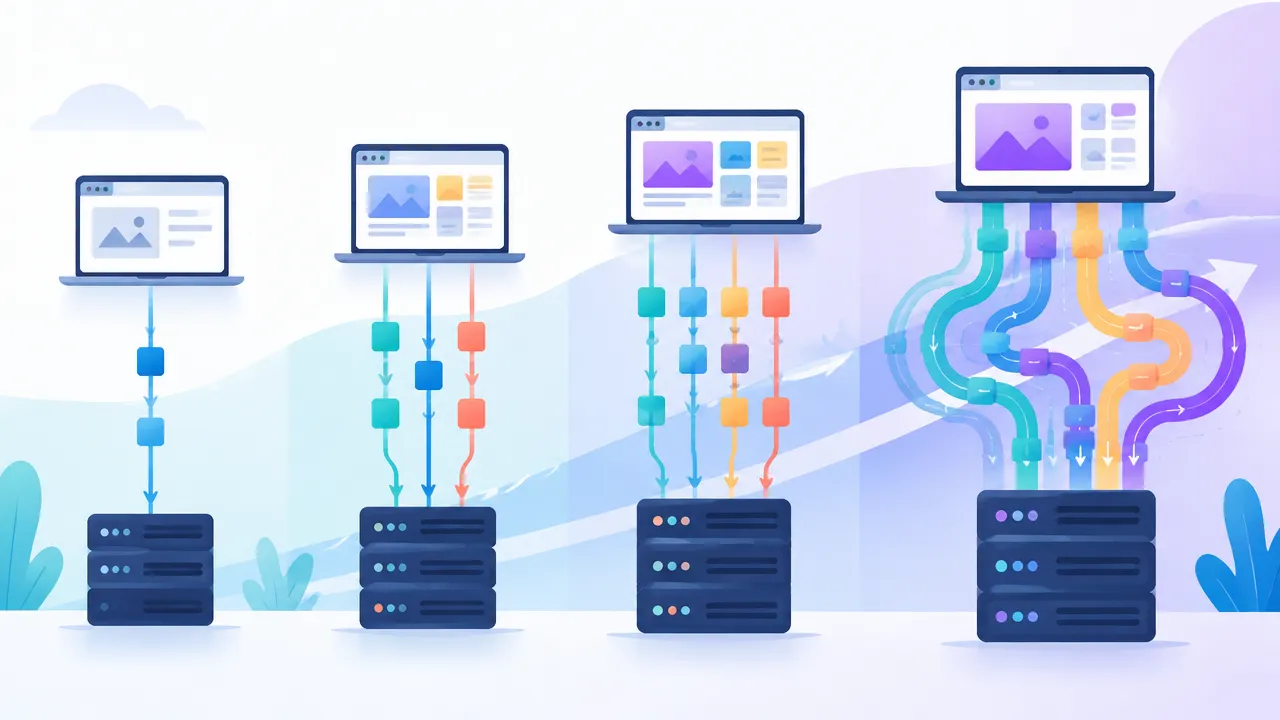
IPv4 and IPv6 are two versions of the Internet Protocol, and websites can support both at the same time. I recommend dual-stack support because it helps a site serve visitors on older IPv4 networks and the growing number of IPv6-enabled networks, without assuming either protocol is faster or more secure by default.
Key takeaways
IPv4 uses 32-bit addresses; IPv6 uses 128-bit addresses.
IPv4 and IPv6 do not automatically communicate with each other.
Dual-stack hosting lets a service accept connections through both protocols.
IPv6 expands address capacity and supports simpler address configuration.
DNS records alone do not prove that a working IPv6 service is available.
How do IPv4 and IPv6 differ?
The main difference is address size, which changes how many unique addresses each protocol can support. IPv4 has 32-bit addresses, while IPv6 has 128-bit addresses, as defined in the IPv6 Internet standard.
Feature | IPv4 | IPv6 |
|---|---|---|
Address length | 32 bits, or 4 octets | 128 bits |
Typical format | 192.0.2.1 | 2001:db8::1 |
Address notation | Decimal numbers separated by periods | Hexadecimal groups separated by colons |
DNS record type | A | AAAA |
Broadcasting | Supports broadcast | Uses multicast and anycast instead of broadcast |
The examples use documentation-only address ranges, not real public server addresses. IPv4 has about 4.3 billion possible address values. IPv6 has 2128 possible values, which gives networks far more room to number devices and organize address space.
Why should a website offer both protocols?
Supporting both helps a website reach visitors across different networks and devices. Some users can connect over IPv6, some remain IPv4-only, and many networks support both. A site available through only one protocol may be unreachable to users whose connection depends on the other.
Adoption is substantial, though measurements vary by method. APNIC Labs reported a global IPv6 capability rate of 43.66% in its 30-day average from September 13 to October 12, 2026. That is a measurement of IPv6 capability, not a guarantee that the same share of every website’s visitors will use IPv6.

Dual-stack support is useful for businesses serving broad audiences, mobile users, international customers, or connected devices. I treat it as an accessibility and infrastructure choice, not a direct SEO ranking signal. The website still needs to work correctly over both routes.
What advantages does IPv6 provide?
IPv6 gives networks more address capacity and options for configuring and organizing devices. Those benefits can simplify growth, especially when a business adds cloud services, mobile systems, or many connected devices.
More address space: Networks have more room to assign addresses without relying as heavily on sharing one public IPv4 address among many devices.
Address auto-configuration: IPv6 supports mechanisms that let devices configure addresses with less manual work.
Different traffic delivery: Multicast and anycast support specific ways to send traffic to groups or a nearby member of a group.
A streamlined base header: IPv6 removes or changes some fields found in IPv4, but that design does not guarantee a faster connection.

IPv6 does not make a network secure by itself, and it does not eliminate every use of NAT. Firewalls, access controls, patching, and monitoring still matter. I also avoid promising speed improvements without comparing actual performance on the networks that matter to the business.
How does dual-stack website deployment work?
A dual-stack website publishes an IPv4 address and an IPv6 address for the same hostname, then accepts connections over both protocols. DNS typically uses an A record for IPv4 and an AAAA record for IPv6. Both records must point to services that are configured and reachable.
Confirm that the hosting provider, load balancer, or content delivery setup supports IPv6.
Configure IPv6 routing, firewall rules, and the web server listener.
Publish the AAAA record only after the IPv6 endpoint is ready to serve traffic.
Check that HTTPS, redirects, access rules, and application behavior work over either route.
Monitor connection errors and response times separately for IPv4 and IPv6.
Because the same hostname serves both routes, I verify the actual IPv6 endpoint instead of assuming that a DNS record is enough. I use the IPv6 auditor to check whether a website is reachable over IPv6. I also keep transport security checks in the deployment process, including TLS configuration checks. For ongoing visibility into related site health, 37 Audits provides continuous website audits and alerts across technical areas such as security, performance, and resilience.
What should teams test before enabling IPv6?
Test IPv6 as a complete route from DNS lookup to application response. A working AAAA record is only one part of that route. A firewall rule, server listener, or application allowlist that handles IPv4 but misses IPv6 can create failures that are easy to overlook.
Resolve the hostname and verify its A and AAAA records.
Request key pages over IPv4 and IPv6, checking status codes, redirects, and page content.
Review logs and security rules to confirm they record and handle IPv6 client addresses correctly.
Compare latency and error rates over time rather than assuming one protocol is faster.
Retest after DNS, hosting, firewall, or CDN configuration changes.
I also compare site behavior across protocols when reviewing website performance monitoring. The goal is to spot meaningful differences in availability or response, then fix the route that is failing.
Frequently asked questions
What are IPv4 and IPv6 addresses?
IPv4 and IPv6 are versions of the Internet Protocol, which assigns addresses and routes data between networks. IPv4 addresses use 32 bits and are usually written as four decimal numbers, such as 192.0.2.1. IPv6 uses 128 bits and hexadecimal groups separated by colons, such as 2001:db8::1.
Is IPv6 faster than IPv4?
No. IPv6 does not automatically make a connection faster. Speed depends on factors such as network routing, peering, server configuration, and congestion. In some cases, IPv6 may improve a route; in others, IPv4 may perform better. I recommend measuring real response times over both protocols before drawing conclusions.
Can IPv4 devices communicate with IPv6 devices?
Not directly in every case. IPv4 and IPv6 are separate protocols, so a device using only one cannot automatically communicate with a device using only the other. Networks can use translation or gateway mechanisms to bridge them. Dual-stack devices and services can use both protocols, which supports a wider range of connections.
Why should a website support both IPv4 and IPv6?
Supporting both protocols lets a website serve visitors whose networks use IPv4, IPv6, or both. IPv6 is already widely deployed, but IPv4-only access remains important. Dual-stack service helps avoid excluding either group, provided the IPv6 route is configured, secured, and monitored rather than merely listed in DNS.
Does IPv6 eliminate the need for NAT?
No. IPv6 reduces the need for address-sharing techniques such as network address translation because it provides a much larger address space. Organizations may still use translation or other network controls for specific purposes. IPv6 also does not remove the need for firewalls, access policies, or careful monitoring.